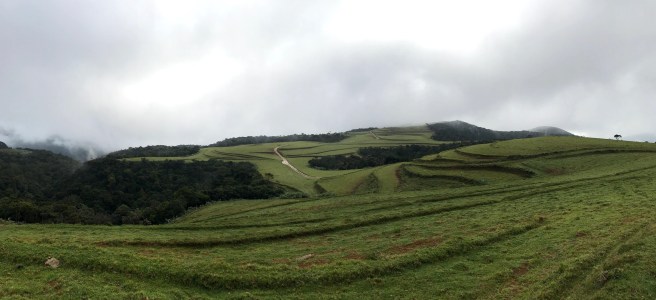
One weekend, my brother so desperately needed a break from his work and we all ended up on our way to Nuwara Eliya, the most populous holiday destination among Sri Lankans, preferred for its cool climate, presenting a welcome and relaxing respite, especially for the ones like us who are constantly wearied from the heat of Colombo. With the time posing limitations on our itinerary (since this was a short excursion of just one and a half days), we chose “Moon Plains” as our main event for the weekend as it was an ideal, short, non-tiring jaunt suiting the occasion. Although there are several attraction sites to visit around Nuwara Eliya, we somehow always manage to end up visiting Horton Plains every time we go to the central highlands. Don’t get me wrong, I love Horton Plains. It is in fact one of my favourite places in the country. But this time around we decided on Moon Plains for a change and because it is relatively unheard of compared with the other, well-known travel destinations. My knowledge of Moon Plains, at the time, was only limited to what I have learned in my grade eleven Geography. I remember it being mentioned alongside Horton Plains as examples for Pathana grasslands.
Moon Plains (in Sinhalese called Sandathenna) is located in Nuwara Eliya District within the Central Province of Sri Lanka. It is located right next to Lake Gregory and is approximately 5 km from the Nuwara Eliya town. Located at a 1950 m elevation from sea level, Moon Plains lie within the upcountry wet zone and is categorised under the “Wet Pathana Grassland” vegetation type based on the plant communities that are present there. Another distinct feature about the Moon Plains area, in addition to the cool safari rides that it is now famous for, is the Moon Plains Sanitary Landfill that was installed in 2004, funded by Japan International Cooperation Agency (JICA). Until its installation, a section of the Moon Plains area had been utilised as an open garbage dumping site under the Municipal Council of Nuwara Eliya. Now, however, the area is renovated and redesigned and is attracting much attention as a tourists attraction spot, with a whole brigade of safari jeeps working in full throttle to keep up with the increasing numbers of both local and foreign tourists that visit the place ever since it was opened as an Agricultural and Environmental Tourism Zone in 2014.
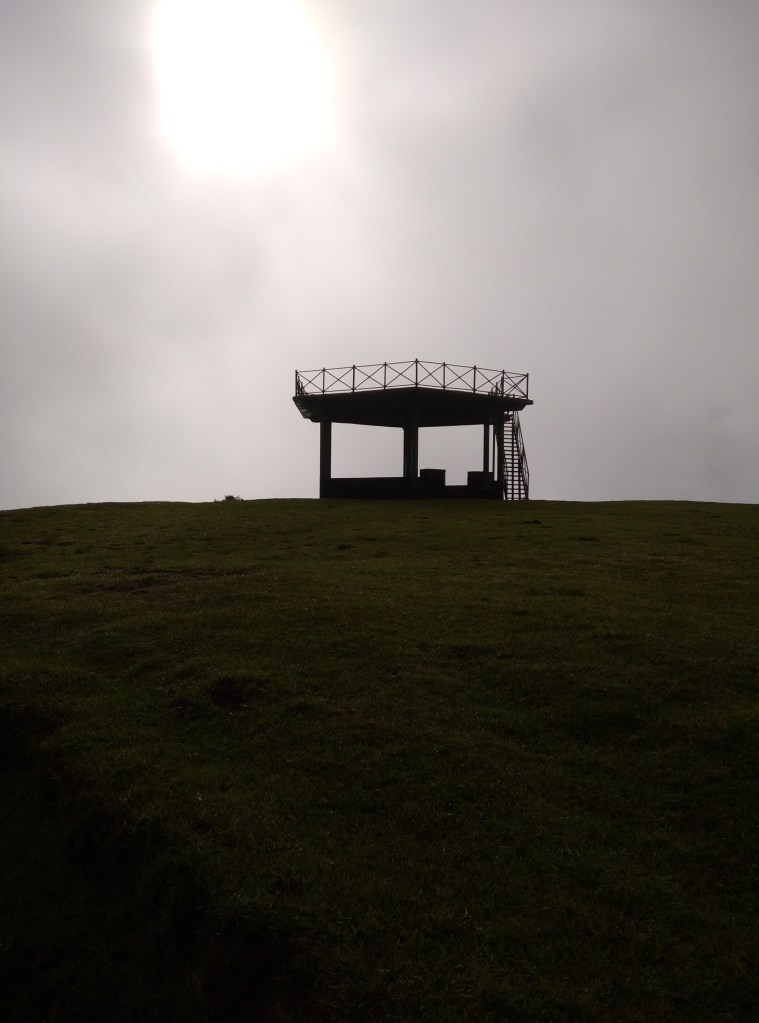
The hexagonal platform installed at the top of Moon Plains viewpoint 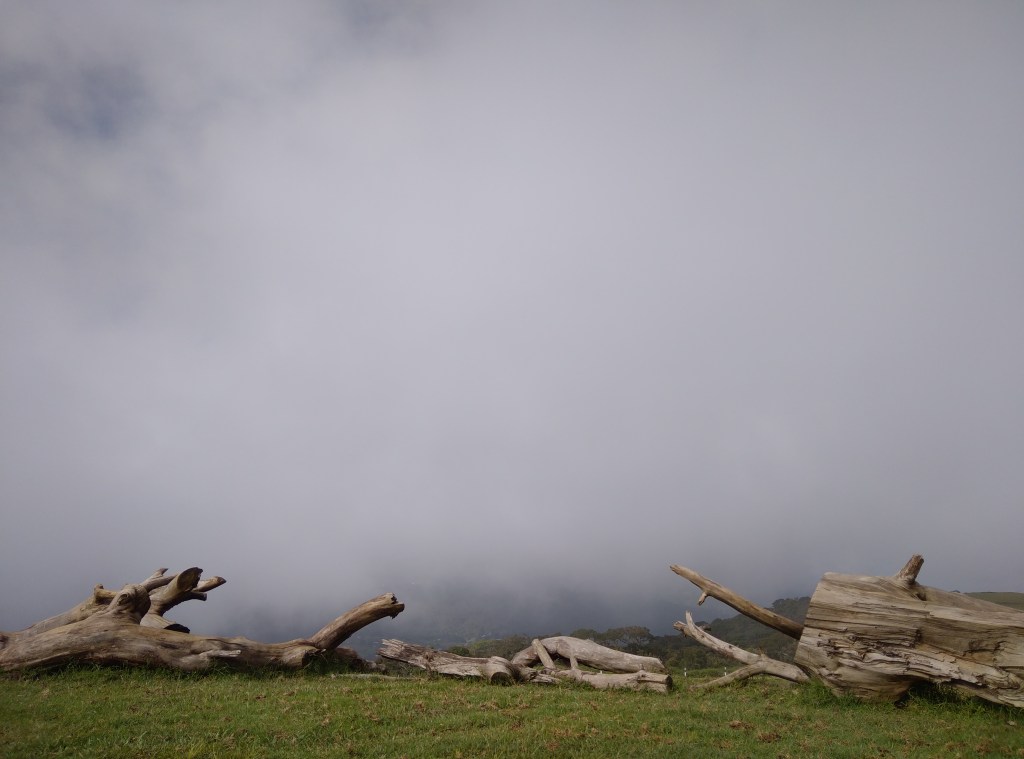
Unfortunately, a thick fog veils the beautiful scenery beyond.
We arrived early in the morning at the location and bought our entry tickets that cost 50 rupees each. As the very first group for the day, we knew we had the advantage of enjoying the location by ourselves without the distraction of other visitors, which is always satisfying. At the entrance, before entering the plains, we had to switch to a safari jeep (which cost 2000 rupees) whose driver became the guide for our oncoming tour. The morning was extremely misty and chilly and we rolled along the bumpy roads that snaked through the plains toward the “Moon Plains Viewpoint”, which is supposed to be the highlight of the tour. At the onset of the ride, we first drove through the greenhouses and the premises of the “government potato seed farm” which comes under the Department of Agriculture, through which the entrance to the plain lies. After passing that area, what rolled on were the vast expanses of grass carpeted hilly undulations, bordered by the dark green patches of cloud forests of the surrounding Kandapola-Seetha Eliya forest reserve, and, of course, the beautiful silence (this reminded me a lot of the landscape of Horton Plains which has a similar vegetation pattern). To add to the excitement, we had sporadic sightings of birds (Moon Plains is said to be home to 105 bird species out of which 16 are endemic), a jungle fowl, a group of wild boars, buffaloes, and bear monkeys (purple-faced leaf monkey) that enlivened the landscape.
From our very amiable guide, we learned that certain parts of the plains are being used for seed potato cultivation with the practice of “crop rotation”. Here, a “ fallowing” type crop rotation is being practiced. This means, after completing one cycle of potato cultivation in one fraction of the field, that land is left fallow (without cultivating). Meanwhile, the remaining portion of land is cultivated. Likewise, seed potatoes are cultivated alternately in two fractions of the field. Through this practice, the soil texture and fertility could be maintained over a longer period by allowing the land to recover, rather than cultivating continuously on the same spot. So, on our journey through the Moon Plains, we were shown both these fallow lands and the ones that are under cultivation.
[Seed potato plants are cultivated to obtain tubers with the sole purpose of replanting, to obtain fresh potato plants for new cultivations. These seed potatoes, generated in these premises, are eventually distributed among the local farmers to initiate individual potato cultivations]
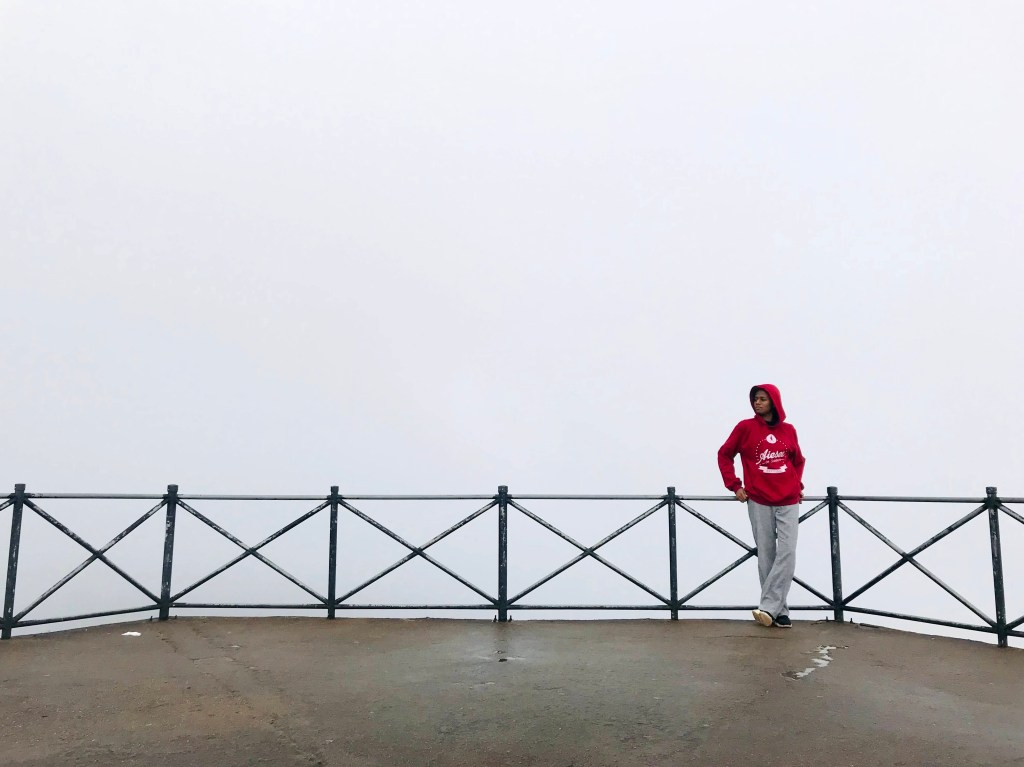
Eventually, we arrived at the viewpoint which is generally referred to as the “ Second World’s End” (the first is in the Horton Plains). There is a small platform that is perched at the very top of the viewpoint from where you can capture a panoramic view of the surrounding hill country. Unfortunately, a very persistent veil of fog that descended while we were at the viewpoint robbed us off of this beautiful scenery. Our guide explained that the view covers two provinces, Uva and Central, and nine mountain peaks, Pidurutalaga, Single Tree Mountain, Kikiliyamana Mountain, Great Western Mountain, Konical Hill Mountain, Kirigalpoththa Mountain, Thotupola Mountain, Hakgala Mountain and Namunukula Mountain, some of which he was able to show us vaguely through the misty veil.
However, we couldn’t stay for long at the viewpoint until the mist cleared out (although we so desperately wanted to) as the jeep ride only permits just one hour for the round trip, per group. Sadly, we departed and made our way back to the entrance and at the very end of our ride, we saw several other groups just starting theirs. If the mist had lifted, they would have probably been able to capture the magnificent scenery that we couldn’t. Anyhow, what is not to like in a relaxing ride through hilly terrain in cold weather in the central highlands of Sri Lanka? Therefore, this Moon Plains excursion is so totally MyCuppaTea.

 MyCuppaTea
Amazing blend of narrative exposition and personal opinion. Indeed, it’s your CupaTea
LikeLiked by 1 person