Too much fun This ain’t right Assure me Tolerate me This soul is made of love Unable to represent Willing to constitute So much care And that ain’t right Genetics they are Please be obsessed Force the key steps hit it, knock it Seek timing for every single count End this November Close this chapter These ain’t right Ain’t right with the wrong person.
~ Ima ~
The poem explores the theme of the rhythm of OCD (obsessive-compulsive disorder) through a series of fragmented thoughts and emotions. The poet expresses a sense of imbalance and dissatisfaction, claiming that too much fun feels wrong and seeking assurance and tolerance from others. They acknowledge their soul is filled with love but feel unable to represent themselves fully. Despite their caring nature, they believe something is inherently wrong. They mention genetics, perhaps alluding to a possible biological or hereditary component of OCD. The poet asks to be obsessed and urges themselves to forcefully follow certain steps or rituals. They use phrases like “hit it, knock it” to emphasize the need for precise actions. They seek a specific timing and rhythm, counting every beat, possibly reflecting the compulsive nature of OCD. The poem concludes with a desire for closure, aiming to end a chapter, symbolically represented by November. The poet suggests that the current situation or relationship feels wrong and emphasizes the mismatch with the wrong person. In summary, the poem delves into the experience of OCD, highlighting its disruptive impact on the poet’s thoughts and emotions. It conveys a sense of longing for balance, understanding, and resolution within the context of this mental health condition.
This is the second song review that I will be undertaking which will again be another Coldplay song. I can’t stress this enough, but I have come across no other lyrical master than Chris Martin himself who intersperses subtle surprises in between his lyrics that I enjoy so much deciphering. Why Èkó? Not so obvious. Well, I could have chosen some mega Coldplay hit to write about, but no, I stick with Èkó for good reason. Èkó used to be a song that I would usually skip in my Coldplay playlist, as initially, it failed to stand out for any reason. But recently, just one single word in this song stood out for me randomly, which got me into diving a bit deeper into its lyrics. The word is “Lagos”. Lagos is a very lively Nigerian city, and I wouldn’t have paid much attention to this if not for the new international companions that I’ve gathered recently from my time in Europe. My Nigerian colleague had passingly mentioned Lagos a few times which caused me to recognise that it’s this city Chris Martin is singing about, and I wanted to dig a little deeper into its lyrics. My colleague’s dissection of it went more perfectly than expected, as he, who comes from Benin (a region just next to Lagos), was a perfect source of information providing a stellar interpretation of the lyrics from his own local point of view, that I would never have been able to come up with.
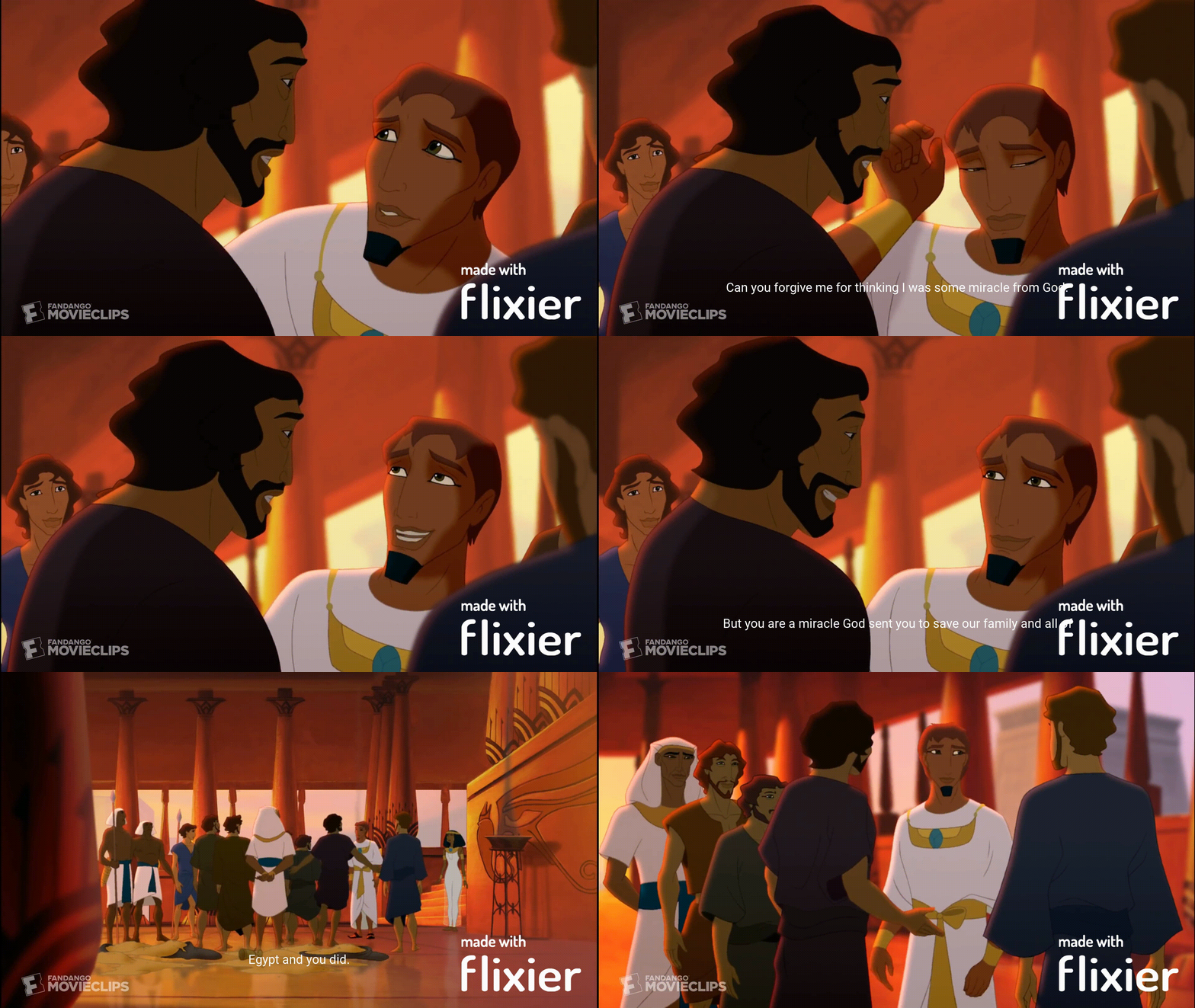
Èkó is the third track of Coldplay’s eighth album “Everyday Life” (sunset side), featuring backing vocals from the Nigerian singer Tiwa Savage. The song’s title “Èkó”, I learned, is a native name for the city Lagos, coined by its first King (Oba), Oba Ado. After trying out several angles, my colleague somehow concluded that the song seems like a narrative of a Nigerian expatriate who is visiting his motherland. So, Joseph, our protagonist, is coming back to Lagos, presumably his hometown, riding in on a “beam of light”, which according to my colleague, indicates a luxurious life that Joseph had had the opportunity to enjoy elsewhere in the world. Africans, seeking greener pastures is not unheard of, especially considering the numbers by which you find Africans in Europe, the USA, Canada, UK, and the boom of university enrolments of African students in these countries. Their determination to go seek better lives is unfortunately driven mostly by the current less-than-ideal economic and political situations that prevail, which is true for most nations nowadays, including mine. One other interesting thing that I learned here is the biblical story of Joseph the dream interpreter, one of the twelve sons of Jacob, who was betrayed by his brothers and sold into slavery in Egypt, where he achieves success in terms of status and wealth, eventually becoming the governor of Egypt. Later, Joseph, a paragon of forgiveness, wisely and nobly sustains the whole country and his brothers during a famine through his good fortune. I couldn’t help but draw parallels between this biblical Joseph and our Joseph from Èkó, who, in a way, seem to be following the same road (If you like, you can check out the animation “Joseph: King of Dreams (2000) by DreamWorks Animation to learn more about biblical Joseph, which I enjoyed watching).
Our Joseph comes back home to the “stray dogs and fights” of Lagos, which, as my colleague points out, are common sights of typical Nigerian urban cities that cause to establish a general populous ethos in the country. And Lagos, specifically, is the most populous city in the country with an ever-increasing population of 15 million people. And, of course, outwardly, the mention of religious establishments (the corrugate cathedrals) in the lyrics comes as no surprise since the majority in Lagos are evangelist Christians and religion is obviously held in high esteem. But why the use of the word “corrugate”? Could it be referring to the actual architecture of these religious establishments, or on a serious note, to the more commonplace, ordinary houses of the common man, supposedly with corrugated roofs which probably are respectable cathedrals to their inhabitants? I personally like to believe this second notion.
And then, the mention of the word “pilgrims” in the song is fascinating to me. Because what I’ve freshly learned was that “foreigners” or rather the alternative forms of people that are different from their own selves, are a factor for excitement and fascination for most Nigerians and are often referred to as “pilgrims”. But now, returning to his motherland, the roles might have been reversed and the rest of the countryfolk our Joseph meets, might come off as “pilgrims” or “foreigners” to him, due to the possible alienation he might have brought upon himself through his ex-pat status. So, instead of his brothers and sisters, “the sight of the pilgrims going nowhere in millions of cars” is what he gets to witness in his mind. They are “going nowhere”, because he might be under the impression that he himself is now going “somewhere”, owing to the luxuries of education or profession, or status that he might have achieved. And “millions of cars” is, well, simply and literally “millions of cars” because this is Lagos! Now, Lagos is only just a “dream”, an unattainable entity, that he probably once had, a dream to see it prosper, grow, and develop. The expectations he had for his country, in terms of the promises he made to himself, to help it grow someday and push it to a better state, have now evidently dissolved into a distant dream. Coming back, he probably realizes now that all his determination might be in vain, for there will be “no harvest”, despite any actions for betterment. Despite the unfortunate state of his motherland, he, a denizen of a continent plump with natural aesthetic beauty, is nevertheless deemed to miss its soul, its magic during his time away, which is portrayed here in the lyrics by the “sky and its circus and the millions of stars”. The sky and the stars could signify the elevation, the glory, and the majesty while the “circus” of colours in the sky reflected in the ever-pervasive entertainment characteristic of the African cultures.
Then comes the chorus of the song, a beautiful conglomeration of words that effectively captures the unique essence of the whole continent and its beauty that screams “Africa”. Personally, to me, the “African-ness” had always been what I felt when I was watching Lion King in my early years as I was growing alongside the magical animation. When the lyrics go “In Africa, the rivers are perfectly deep and beautifully wide”, I can think of nothing else but the opening to the movie and the way how the sun rises over the savannah, and over the glistening rivers with “Nants ingonyama bagithi baba” in the background.
Here’s a bit of the opening clip from Lion King, my favourite animation movie and how I first got introduced to Africa.
However, it’s not just that the waters and rivers, as a natural phenomenon, are always associated with the playfulness, unity, and harmony among the civilizations that benefitted from them, but also, another brilliant interpretation of my colleague states how the waters of Africa can connect both black and white nations in this diverse land mass of Africa, as the rivers meander along merging and dissolving a continent of multiple hues into one single entity. This connection with the waters and rivers is again emphasised later in the song with the line, “We dance in the water and hold each other so tight”. Again, stressing on the unity, harmony, and connection of a connected nation through and through, which Joseph had probably missed. The kind of emotional comfort and homeliness that you experience in your own country or home, which you are generally deprived of once you move away, is brilliantly highlighted in the part, “The mothers will sing you to sleep and say, “It’s alright, child It’s alright””. Who else can make you feel at home than your own mothers, these strangely designed group of people, the fountains of unconditional love, who would reassure you and say that everything is alright, even when nothing is, sometimes, which is something unfortunate and universal to most of the poor nations in the world.
So, Chris Martin sings about Lagos and Africa alternately in the verses and the chorus, which made my colleague suggest the idea that he might probably be using Nigeria and Lagos as a reference point to talk about Africa in general. Finally, toward the song’s end, we see that Joseph “dreams of his queen by his side”. Could this “queen” be his actual wife, whom he wishes to spend the beautiful “sunset” of his life with, or, as my colleague sees, his country could be as important to him as a “queen” for whom he wishes the best possible fate, that is to witness her as a bride, beautiful and adorned, indicating the never-dying love and hope our ex-pat still carries in his heart for his dear motherland.
Furthermore, we should definitely consider Chris Martin’s own original definition of the song which goes like this:
Here is the song called Èkó, which some of you may know as, the sort of local word for Lagos, one of the big cities in Nigeria, it’s also known as Èkó. And this song is about a guy called Joseph who is just a made-up character but, could be me or and also could be someone who leaves the countryside to try and make it in the city. It’s actually what I did and what we all did in the band and cities are tough, and lonely, and amazing, and uplifting, and all sort of things rolled into one. And this is the song “Èkó
Our take on the song might be a bit straying off from what Chris Martin originally had in mind, but as Chris himself says in his interview, “Chris Martin on Uninterrupted Disruption – Everyday Life Track by Track”, he doesn’t really like to explain the songs, as he doesn’t seem to understand them himself (so humble). So, let’s all assume that it’s alright to come up with our own interpretation for it as well, which also seems fitting and plausible in our eyes. Furthermore, I highly recommend you check out this interview, where he walks you through all the songs of the album “Everyday Life” (Please check out this great interview from the link below). This album has got to be one of my favourite Coldplay albums where the overall theme takes a turn from more general notions like love, to discussing more practical societal challenges currently faced by human beings, thereby diverting our awareness to where it’s actually required. Èkó, as a part of this great album that exudes the “humanness” of everyday life, is now a gem that I have recently unearthed and is therefore totally MyCuppaTea.
Check out the lyrics to the song :
Joseph rode in on a beam of light Stray dogs to welcome him, fights, corrugate cathedrals The sight of the pilgrims going nowhere in millions of cars
Lagos a dream in the distance From promises he’d made behind Where there was no harvest But he missed the sky and its circus And countless, the stars
In Africa The rivers are perfectly deep And beautifully wide In Africa The mothers will sing you to sleep And say, “It’s alright, child It’s alright”
In Africa We dance in the water and hold Each other so tight In Africa The mothers will sing you to sleep And say, “It’s alright, child It’s alright”
Joseph rode in on a beam of light And dreamed of his queen by his side There’ll be a beautiful sunset And you’ll be a beautiful bride










 MyCuppaTea